 Anse Accounting Corp.
Changing the accounting and tax adviser of a Korean subsidiary does not have to leave a gap in filings. This guide covers the cut-off dates that work best, how the new adviser gets Hometax access, the records to take over, and what to check in the first weeks.
When is the best time to switch?
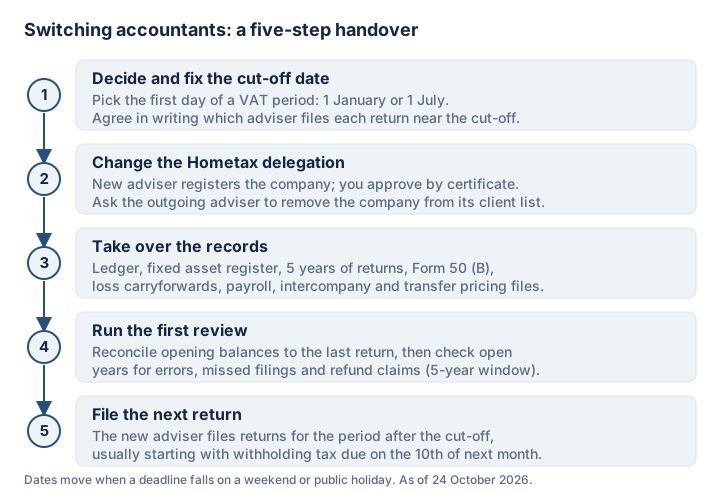
The cleanest cut-off is the first day of a VAT period: 1 January or 1 July. VAT runs in two six-month periods, and the final return for each is due 25 days after it ends, on 25 July and 25 January (Value-Added Tax Act, Arts. 5 and 49). Most corporations also file preliminary returns by 25 April and 25 October (Art. 48). On a period boundary, each VAT return comes from one set of books.
Then settle who files the returns that straddle the cut-off. With a 1 January cut-off, several filings for the old year fall due after the switch:
| Cut-off | Filing for the earlier period | Due date |
|---|---|---|
| 1 January | December payroll withholding | 10 January |
| 1 January | VAT final return, July–December | 25 January |
| 1 January | Year-end payroll settlement; employment income payment statements | February pay; 10 March |
| 1 January | Corporate tax return (December year-end) | 31 March |
| 1 July | VAT final return, January–June | 25 July |
| 1 July | Interim corporate tax for the first six months | 31 August |
Withholding tax is paid by the 10th of the following month (Income Tax Act, Art. 128(1)). Year-end settlement runs with February salaries, and employment income statements are due by 10 March (Arts. 137 and 164). The corporate tax return is due within three months after the month the fiscal year ends (Corporate Tax Act, Art. 60(1)). Interim tax is due within two months after the first six months (Art. 63). Dates move for weekends and public holidays.
Avoid a February or March cut-off unless the current adviser is clearly failing. Deciding now, a 1 January 2027 cut-off is realistic.
How does the new adviser get access to Hometax?
The new adviser registers your company as a client in Hometax and the company approves it. The adviser enters your business registration number and contact details and keeps a signed consent form. The company then consents online with its certificate, or in writing at the tax office (NTS Rules on the Use of Hometax, Art. 55). The adviser can then see your tax invoices, card sales, notices, refunds and arrears (Art. 54).
Ask the outgoing adviser to remove your company from its client list. Then check the "My tax agent information" (나의 세무대리정보 관리) menu to confirm who still has access. Keep the corporate certificate and Hometax login under the company's control.
Confirm that the new firm is registered for tax representation; a CPA must be entered in the CPA tax agent register (Certified Tax Accountant Act, Art. 20-2). Where a company's tax adjustment must be prepared externally, it must come from a member of a designated adjustment team (Corporate Tax Act, Art. 60(9)).
What records should you take over?
Take over everything needed to continue the books and defend past returns, not just the financial statements. Filed returns can be downloaded from Hometax; the ledger, working papers and adjustment schedules generally sit only with the outgoing adviser.
| Record | Why it is needed | Who usually has it |
|---|---|---|
| General ledger and journal entries, with supporting documents | Opening balances; records must be kept 5 years (7 for cross-border transactions) | Outgoing adviser; originals with the company |
| Fixed asset register | Depreciation, including book–tax differences | Outgoing adviser |
| Tax adjustment statements, including Form 50 (B), Statement of Capital and Reserve Adjustments | Book–tax difference balances carry into every later return | Outgoing adviser |
| Loss carryforward schedule | Losses are deductible for up to 15 years, capped at 80% of income (100% for SMEs) | Outgoing adviser |
| Last 5 years of corporate tax, VAT and withholding returns | Refund claims and audits reach back 5 years | Hometax; outgoing adviser |
| Withholding returns and payment statements | Payroll continuity and year-end settlement | Outgoing adviser or payroll provider |
| Social insurance filings (pension, health, employment, industrial accident) | Payroll base and staff changes | Payroll provider |
| Intercompany agreements, invoices, international transaction statements | Statements are due within 6 months after the year-end month | Outgoing adviser; head office |
| Transfer pricing documentation | The tax office can request it with 60 days to respond | Head office or TP adviser |
| Shareholder register, registry extract, articles | Share changes are reported with the corporate tax return | Company; corporate lawyer |
Losses from fiscal years beginning on or after 1 January 2020 carry forward for 15 years; older losses keep the 10-year limit (Corporate Tax Act, Art. 13(1); Addenda to Act No. 17652, Arts. 4 and 15). Master and local files are required where revenue exceeds KRW 100 billion and cross-border related-party transactions exceed KRW 50 billion, due within 12 months after the year-end month (Adjustment of International Taxes Act, Art. 16; Decree, Art. 34).
What should the new adviser check first?
First, reconcile the opening position to the last return filed. Then look for problems in the years still open:
- Reconcile Form 50 (B) closing balances to the ledger. A wrong balance distorts every later return.
- List each loss by year of origin and expiry. Only losses included in a filed or assessed return can be deducted (Corporate Tax Act, Art. 13(1)).
- Find missed or wrong filings. An amended return cuts the under-reporting penalty by 90% within 1 month after the deadline, tapering to 10% at 18 to 24 months. The cut is lost if you amend because a reassessment is coming (Framework Act on National Taxes, Art. 48(2)).
- Find overpayments. A refund claim can be filed within 5 years after the filing deadline (Art. 45-2(1)).
- Check that international transaction statements and any transfer pricing files were filed on time.
Does an external audit affect the switch?
Yes. An audited company's auditor cannot also keep its books: the auditor may not prepare the financial statements or advise on the accounting behind them (Act on External Audit of Stock Companies, Art. 6(6)).
A company is audited if it is listed or about to list, or if at the previous year-end it had assets or revenue of KRW 50 billion or more. Two of four tests also trigger an audit: assets of KRW 12 billion, liabilities of KRW 7 billion, revenue of KRW 10 billion, or 100 employees (Art. 4(1); Decree, Art. 5(1)). A limited liability company (yuhan hoesa) below KRW 50 billion needs three of five tests, the fifth being 50 members (Decree, Art. 5(2)).
The auditor must be appointed within 45 days after the fiscal year begins, or within 4 months if the company was not audited the year before (Act, Art. 10). If the audit runs late, the corporate tax deadline can be extended by up to one month on application (Corporate Tax Act, Art. 60(7)).
How long must records be kept after you switch?
Keep books and supporting documents for 5 years from the filing deadline, or 7 years for cross-border transactions (Framework Act on National Taxes, Art. 85-3(2)). For a loss year, keep them longer if the loss is used later: that year stays open until 1 year after the filing deadline of the year the loss is deducted (Art. 26-2(3)). This duty stays with the company, so keep your own copies.
Common mistakes
- Leaving the cut-off undefined, so each adviser assumes the other is filing.
- Taking the financial statements but not Form 50 (B) and the loss schedule.
- Leaving the old adviser's Hometax access, or the corporate certificate, in place.
- Losing the intercompany and transfer pricing files in the handover.
FAQ
Can the new adviser amend a return prepared by the old one?
Yes. The company is the taxpayer, so the new adviser can prepare an amended return or refund claim for any open year.
What if the outgoing adviser is slow to hand over records?
Start with what the company can retrieve itself: filed returns, payment statements and electronic tax invoices are in Hometax. The ledger and working papers are not, so request them in writing with a deadline.
Our auditor offers to keep the books as well. Is that allowed?
Not if the company is audited. The external audit law bars the auditor from preparing the financial statements it audits.
How we can help
We take over Korean subsidiaries' accounting and tax work from other advisers. We agree the cut-off with you, check opening balances against the last returns, and flag early any open year that needs correcting. Our directors work in English and report in your head office's format.
Arrange a free 30-minute consultation
Sources & further reading
- National Law Information Center — Corporate Tax Act
- National Law Information Center — Value-Added Tax Act
- National Law Information Center — Income Tax Act
- National Law Information Center — Framework Act on National Taxes
- National Law Information Center — Adjustment of International Taxes Act
- National Law Information Center — Enforcement Decree of the Adjustment of International Taxes Act
- National Law Information Center — Act on External Audit of Stock Companies
- National Law Information Center — Enforcement Decree of the Act on External Audit of Stock Companies
- National Law Information Center — Certified Tax Accountant Act
- National Law Information Center — NTS Rules on the Use of Hometax (Notice 2026-3)
- Korea Legislation Research Institute — Statutes of the Republic of Korea (English)
- National Tax Service (English)
This article provides general information. Its application depends on your circumstances and the rules in force at the relevant time.