 Anse Accounting Corp.
Korea withholds 22% on dividends, most interest and royalties paid to a foreign company, unless the foreign recipient claims a lower treaty rate before payment. This guide sets out the treaty rates for 13 major investor countries, explains when local income tax is added on top, and walks through the application and refund procedure.
When a Korean subsidiary pays a dividend, interest or a royalty to a foreign company, it must withhold Korean tax and pay it by the 10th of the following month (Corporate Tax Act, Article 98(1)). The rate depends on the type of income, the treaty, and whether the paperwork arrived in time.
What does Korea withhold if no treaty rate is claimed?
Korea withholds 20% corporate tax on dividends, royalties and most interest, and 14% on interest from bonds issued by the Korean government, local governments or Korean companies (Corporate Tax Act, Article 98(1)). Local income tax of 10% of the withheld corporate tax is added on top and collected by the same payer (Local Tax Act, Article 103-52), and it follows the same payment deadline.
| Income paid to a foreign company | Corporate tax | Local income tax | Total withheld |
|---|---|---|---|
| Dividends | 20% | 2% | 22% |
| Interest on bonds issued by Korean government bodies or companies | 14% | 1.4% | 15.4% |
| Other interest, including intercompany loans | 20% | 2% | 22% |
| Royalties | 20% | 2% | 22% |
For non-resident individuals, Income Tax Act Article 156(1) sets the same national rates; this article focuses on companies.
Is local income tax included in the treaty rate?
For 12 of the 13 countries below, yes: the treaty rate is the cap on all Korean tax combined, corporate tax plus local income tax. The United States is the exception, and there local income tax is added on top of the treaty rate.
It turns on each treaty's "taxes covered" article. Most of Korea's treaties list local income tax, or the older "inhabitant tax" it replaced, and National Tax Service rulings apply those rates as all-in (for China, "5% (local income tax included)", 서면-2020-국제세원-2515). The Korea–US treaty covers only "the income tax and the corporation tax" (Article 1), and NTS rulings collect the local tax separately (서이46017-11633, 2003). A US parent eligible for the 10% dividend rate therefore generally bears 11% in total.
How an all-in rate is split between the two taxes on the return is a filing detail to confirm in your case.
What are the treaty rates for the main investor countries?
Maximum Korean rates under each treaty, as amended by later protocols, checked article by article on 24 October 2026.
| Country | Dividends | Interest | Royalties |
|---|---|---|---|
| United States (local tax added on top) | 10% if a company has owned 10%+ of voting stock and a passive-income test is met; otherwise 15% | 12% | 10% for copyrights and films; 15% for other royalties |
| Japan | 5% if a company has held 25%+ of voting shares for the 6 months before the end of the accounting period; otherwise 15% | 10% | 10% |
| China | 5% if a company (not a partnership) directly holds 25%+ of capital; otherwise 10% | 10% | 10% |
| Singapore (2019 agreement) | 10% if a company directly holds 25%+ of capital; otherwise 15% | 10% | 5% |
| Hong Kong | 10% if a company directly holds 25%+ of capital; otherwise 15% | 10% | 10% |
| United Kingdom | 5% if a company controls 25%+ of voting power; otherwise 15% | 10% | 2% for equipment; 10% for other royalties |
| Germany | 5% if a company directly holds 25%+ of capital; otherwise 15% | 10% | 2% for equipment; 10% for other royalties |
| France | 10% if a company directly holds 10%+ of capital; otherwise 15% | 10% | 10% |
| Netherlands | 10% if a company directly holds 25%+ of capital; otherwise 15% | 10% on loans over 7 years; otherwise 15% | 15% for copyrights (including films); 10% for other royalties (patents, trademarks, designs, know-how, equipment) |
| Luxembourg | 10% if a company directly holds 10%+ of capital; otherwise 15% | 5% if paid to a bank; otherwise 10% | 5% for equipment and know-how; 10% for other royalties |
| Switzerland | 5% if a company directly holds 10%+ of capital; otherwise 15% | 5% if paid to a bank; otherwise 10% | 5% |
| Canada | 5% if a company directly controls 25%+ of voting power; otherwise 15% | 10% | 10% |
| Australia | 15% | 15% | 15% |
Exemptions for interest paid to governments, central banks and export-credit agencies are not shown. Each treaty defines "royalties" differently, so equipment rental or software may fall in a different row or outside the article altogether.
Taiwan has no tax treaty with Korea. Instead, an arrangement between the two representative offices, given effect in Korea by a separate Act, caps dividends, interest and royalties at 10% each, local income tax included.
What is different about the Korea–US treaty?
The 1976 Korea–US treaty differs from Korea's other treaties in four ways that change the withholding result.
- Local income tax is added on top, so the 10%, 12% and 15% rates generally become 11%, 13.2% and 16.5%.
- The 10% dividend rate has two conditions (Article 12(2)(b)). The recipient company must have owned 10%+ of the payer's voting stock during the current tax year up to payment and the whole prior year, and no more than 25% of the payer's prior-year gross income may be interest or dividends (with exclusions). A newly acquired stake can start at 15%.
- Royalties are Korean-source only if the property is used in Korea (Article 6(3)). Domestic law treats a patent not registered in Korea as used here if its technology is in fact used in Korean manufacturing (Corporate Tax Act, Article 93(8)(c)). Do not assume such royalties are untaxed.
- A holding-company rule (Article 17) denies these articles to a company taxed substantially less on the income under special measures and 25%+ owned by persons who are not individual residents of its country.
How does the foreign company claim the treaty rate?
The beneficial owner must give the Korean payer an application for the reduced treaty rate, with documents proving that it is the beneficial owner, before it receives the payment (Corporate Tax Act, Article 98-6(1); Enforcement Decree, Article 138-7(1)). A tax residence certificate is commonly requested as part of that evidence. The beneficial owner is the person that bears the legal or economic risk of the income and can dispose of it (Corporate Tax Act, Article 93-2(1)).
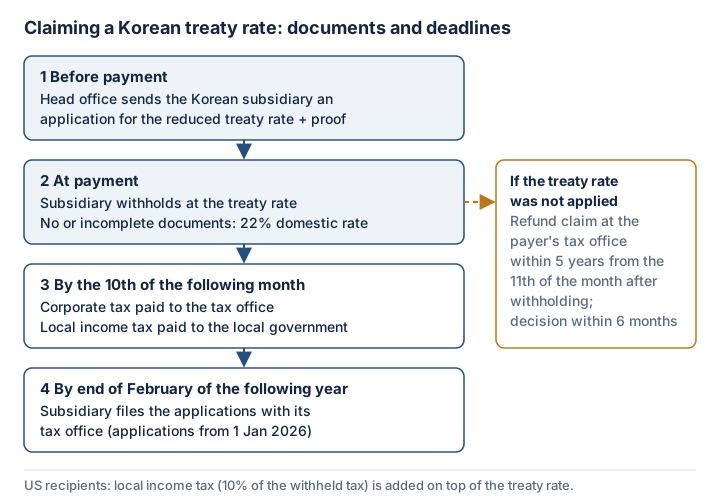
- Before payment: the head office sends the application and its beneficial-ownership evidence to the Korean subsidiary. If the income is paid through an overseas investment vehicle such as a fund, the vehicle also collects applications from the investors and files an overseas investment vehicle report (Article 98-6(2)).
- At payment: the subsidiary checks the documents and withholds at the treaty rate. If the documents are missing, incomplete, or do not identify the beneficial owner, it must withhold at the full domestic rate (Article 98-6(3); Decree, Article 138-7(7)).
- By the 10th of the following month: the subsidiary pays the corporate tax to the tax office and the local income tax to the local government.
- By the end of February of the following year: the subsidiary submits the applications it received to its tax office (Article 98-6(4)). This requirement is new and applies to applications made from 1 January 2026.
An application stays valid for 3 years unless its contents change (Decree, Article 138-7(6)), and the payer keeps the file for 5 years (Article 138-7(8)).
Illustrative example: a Korean subsidiary declares a dividend of KRW 1 billion to its Japanese parent, which has held 30% of the voting shares for well over six months. With a valid application on file, total Korean tax is KRW 50 million (5%, local tax included). Without one, the subsidiary must withhold KRW 220 million (22%), and the parent has to claim back KRW 170 million.
What if the reduced rate was not applied at payment?
The beneficial owner or the Korean payer can file a refund claim with the payer's tax office within 5 years from the 11th of the month after withholding (Corporate Tax Act, Article 98-6(5)); the office must decide within 6 months (Article 98-6(6)). The same route corrects a wrongly applied treaty rate.
The local income tax portion is refunded separately on the local tax side; plan for that second step.
Common mistakes
- Paying first, documents later. Without the application before payment, 22% applies and the excess can only be recovered through a refund claim, which the tax office has 6 months to decide.
- Quoting the original treaty text. Protocols changed the rates for France, Luxembourg and Switzerland.
- Assuming a holding company is the beneficial owner. Korea looks through intermediaries. The UK treaty has main-purpose tests in Articles 10–12, a 2019 protocol added one to the Swiss treaty, and the multilateral convention (MLI) took effect for Korea on 1 September 2020.
- Forgetting the US local tax: a 10% US dividend rate costs 11%.
- Letting applications lapse after 3 years, or after an ownership or residence change.
FAQ
Do we need a new application for every dividend?
No. It remains valid for 3 years unless its contents change, in which case an update is due before the next payment.
Who files the refund claim, the head office or the Korean subsidiary?
Either can, at the withholding agent's tax office within the 5-year window (Article 98-6(5)).
Is interest on an intercompany loan taxed at the 14% bond rate?
Generally no. The 14% rate is for bonds issued by Korean government bodies or companies; ordinary loan interest falls under 20% before treaty relief.
Are these rates changing?
Amendments to Article 98 take effect on 1 January 2027 and 1 January 2028, but keep the 20% and 14% rates for these income types. Treaty rates change only through new treaties or protocols.
How we can help
We check which treaty rate your group can rely on and prepare the application and beneficial-ownership file before the payment date. Where tax has already been over-withheld, we prepare the refund claim within the 5-year window. We work in English and reply within one business day.
Arrange a free 30-minute consultation
Sources & further reading
- Corporate Tax Act (Articles 93, 93-2, 98, 98-6)
- Enforcement Decree of the Corporate Tax Act (Article 138-7)
- Income Tax Act (Articles 156, 156-6)
- Local Tax Act (Article 103-52)
- Korean statutes in English (KLRI)
- National Tax Service — tax treaties and rulings
- OECD — Multilateral Convention to Implement Tax Treaty Related Measures (MLI)
This article provides general information. Its application depends on your circumstances and the rules in force at the relevant time.