 Anse Accounting Corp.
Invest KOREA puts the official process for a foreign-invested subsidiary at about two weeks, but that clock starts only once head-office documents are legalized and ready. This guide walks through each step, who handles it, what it needs, and the tax filings that start the moment the company exists.
How long does it take to set up a company in Korea?
About two weeks for the official steps, according to Invest KOREA, the government's investment promotion agency. That figure covers foreign investment notification, capital remittance, court registration, tax registration, the corporate bank account and foreign-invested company registration, and it assumes every document is already in hand.
The two-week figure does not include the work done abroad before anything is filed in Korea. Head-office documents usually have to be apostilled, or notarized by the Korean consulate if the home country is not party to the Apostille Convention, and Invest KOREA does not put a time on that stage. Bank onboarding and sector licences also run on their own schedules. For a realistic plan, budget several weeks for preparation abroad and treat one to two months as the working window from first instruction to an operating account.
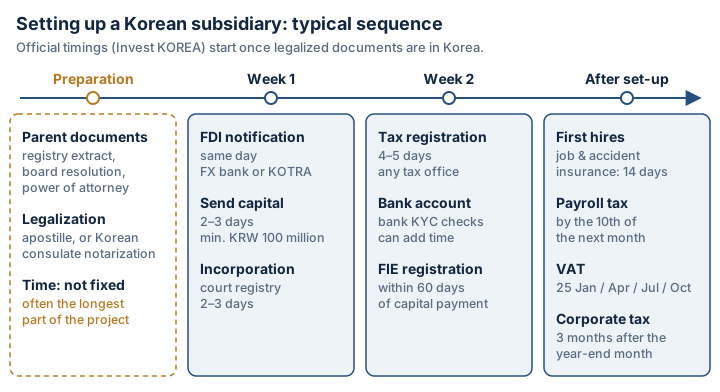
What are the steps, and who handles each one?
There are eight practical steps, and the order matters: the investment must be notified before the money is sent, and the tax office will ask for evidence of both.
| Step | Handled by | Typical time (Invest KOREA) | Key documents |
|---|---|---|---|
| 1. Prepare and legalize head-office documents | Home-country notary, apostille authority or Korean consulate | Not stated; often the longest stage | Typically the parent's certificate of incorporation, board resolution, power of attorney and directors' passports |
| 2. Foreign investment notification | Foreign exchange bank or KOTRA | Same day | Notification form (two copies), proof of investor's nationality, power of attorney if filed by an agent |
| 3. Remit capital | Foreign exchange bank | 2–3 days | Wire to a temporary account; bank issues a payment certificate, or a balance certificate if capital is under KRW 1 billion |
| 4. Register the incorporation | Court registry office | 2–3 days | Application documents listed by the Supreme Court Internet Registry Office |
| 5. Business registration (tax) | Any tax office | 4–5 days | Application, articles of incorporation, office lease, registry certificate, shareholder list, foreign currency purchase certificate, representative's passport, investment notification |
| 6. Open the corporate bank account | Foreign exchange bank | Immediate, in Invest KOREA's table | Registry certificate, business registration, corporate seal and seal certificate, representative's passport, shareholder list including beneficial owner |
| 7. Register as a foreign-invested company | The bank or KOTRA office that took the notification | Immediate; legal deadline 60 days after capital is paid | Not listed by Invest KOREA; confirm with the receiving office |
| 8. Social insurance and payroll | Korea Workers' Compensation and Welfare Service and other insurers | Employment and accident insurance: within 14 days | Employment contracts, payroll set-up |
On step 5, the law is tighter than the table: the tax office must issue the registration certificate within two working days of the application, extendable by up to five days if it decides to inspect the premises (VAT Act Enforcement Decree, Art. 11(5)). Corrections it requests do not count toward that period. If the business needs a licence (food, health, education and many regulated services), the permit comes between incorporation and tax registration, and its timing depends entirely on the authority.
What does the KRW 100 million minimum actually require?
For a share investment to count as foreign direct investment, the amount must be at least KRW 100 million, and the foreign investor must either hold 10% or more of the voting shares or appoint or dispatch an executive to the company (Foreign Investment Promotion Act Enforcement Decree, Art. 2(2)). Where two or more foreigners invest together, the KRW 100 million test applies to each investor separately (Art. 2(3)).
The notification must be filed in advance of the investment (Foreign Investment Promotion Act, Art. 5(1)). After the capital is paid in, the investor or the company must register as a foreign-invested company within 60 days (Enforcement Decree, Art. 27(1)). Registration can also be made before payment is complete if the KRW 100 million and 10% conditions are met (Act, Art. 21(2); Decree, Art. 27(2)).
A branch or liaison office of a foreign company follows a different route under the Foreign Exchange Transactions Act and has no KRW 100 million minimum.
Where does the D-8 visa fit in?
The D-8 (corporate investment) visa follows the company, not the other way round. Under the Immigration Act Enforcement Decree (Annex 1-2, item 11(a)), D-8 covers essential professionals who will manage, or work in production or technology at, a foreign-invested company under the Foreign Investment Promotion Act, as recognized by the Minister of Justice. People hired locally in Korea are excluded.
Invest KOREA notes that the residence visa is issued after the company is registered. Immigration applies its own documentary requirements on top of the corporate steps, so confirm them with the immigration office before fixing a start date for the person who will run the company.
What tax filings start as soon as the company exists?
Several deadlines start on the day of incorporation or the first day of business. All of them apply from the first month.
| Obligation | Deadline | Basis |
|---|---|---|
| Business registration | Within 20 days of starting business; may be filed earlier | VAT Act, Art. 8(1) |
| Corporate establishment report | Within 2 months of incorporation; treated as filed once business registration is made | Corporate Income Tax Act, Art. 109(1) |
| Payroll withholding tax | By the 10th of the month after payment; half-yearly if 20 or fewer employees and approved | Income Tax Act, Art. 128; Decree Art. 186 |
| VAT preliminary returns | 25 April and 25 October | VAT Act, Art. 48(1) |
| VAT final returns | 25 July and 25 January | VAT Act, Art. 49(1) |
| Corporate income tax return | Within 3 months after the end of the month in which the fiscal year ends | Corporate Income Tax Act, Art. 60(1) |
The first fiscal year starts on the date of incorporation registration (Corporate Income Tax Act Enforcement Decree, Art. 4(1)) and cannot exceed one year (Act, Art. 6(1)). If the articles do not set a fiscal year, report one with the business registration; otherwise the calendar year applies (Art. 6(2) and (5)). A newly incorporated company does not make an interim corporate tax prepayment in its first fiscal year (Art. 63(1)).
For VAT, the first preliminary period runs from the start of business, or from the registration application date if the company registered early, to the end of that quarter (VAT Act, Art. 48(1)). A corporation whose supplies in the previous VAT period were under KRW 150 million receives a tax notice for the preliminary period instead of filing a return (VAT Act, Art. 48(3); Decree, Art. 90(4)).
Illustrative example: a subsidiary registered on 2 November 2026 with a December year-end has a first fiscal year of 2 November to 31 December 2026. Its first corporate tax return is due by 31 March 2027, Its first VAT period runs from the business start date (or the earlier registration application date) to 31 December 2026, with the final return due by 25 January 2027 (VAT Act, Art. 5(2) and 49(1)).
Common mistakes
- Starting the two-week clock too early. The official timeline begins when legalized head-office documents arrive in Korea, not when the board approves the project.
- Sending capital before the investment notification. The notification must come first, and the tax office will ask for the foreign currency purchase certificate that ties the money to it.
- Signing the office lease late. A lease is one of the documents for business registration (VAT Act Enforcement Decree, Art. 11(3)), so the address has to be settled before step 5.
- Treating the bank account as instant. Banks check the beneficial owner and the source of funds, and incomplete ownership charts are a frequent cause of delay.
- Forgetting the 60-day foreign-invested company registration. It is easy to overlook once the company is operating, but it is a statutory deadline.
FAQ
Does the capital have to be exactly KRW 100 million?
No. KRW 100 million is the minimum per foreign investor for the investment to qualify as foreign direct investment. You can inject more, and it is worth sizing the capital to cover operating costs until revenue starts.
Can we register for VAT before we start trading?
Yes. A business that is about to start may apply for registration before its business start date (VAT Act, Art. 8(1)). If it does, the first VAT preliminary period starts on the application date.
When is the first corporate tax return due?
Three months after the end of the month in which the first fiscal year ends. With a December year-end, that is 31 March of the following year, even if the company traded for only a few weeks.
Do we need to register for social insurance before hiring anyone?
Employment and industrial accident insurance must be reported within 14 days after the insurance relationship arises, which in practice generally means once the company starts its business with employees (Employment and Industrial Accident Insurance Premium Collection Act, Art. 11(1)).
How we can help
We coordinate the Korean side of the set-up with your lawyers and bank, so tax registration, payroll and the first VAT and corporate tax filings are ready when the company is. Our partners advise in English, and we reply within one business day.
Arrange a free 30-minute consultation
Sources & further reading
- Invest KOREA, Establishment of a foreign-invested company
- Invest KOREA, Definition of foreign direct investment
- Foreign Investment Promotion Act
- Enforcement Decree of the Foreign Investment Promotion Act
- Value-Added Tax Act
- Corporate Income Tax Act
- Income Tax Act
- Enforcement Decree of the Immigration Act
- National Tax Service (English)
This article provides general information. Its application depends on your circumstances and the rules in force at the relevant time.