 Anse Accounting Corp.
Korea raised every corporate income tax bracket by one percentage point for fiscal years beginning on or after 1 January 2026, so national rates now run from 10% to 25%, with local income tax on top. This guide covers the brackets, the annual filing calendar for a December year-end company, loss carryforward limits and the points a new foreign-owned subsidiary most often misses in its first year.
What are Korea's corporate income tax rates for 2026?
National corporate income tax is charged at 10% on the first KRW 200 million of taxable income, 20% on income up to KRW 20 billion, 22% up to KRW 300 billion and 25% above that (Corporate Income Tax Act (CITA), Art. 55(1)). Each rate is one percentage point higher than in 2025. The new rates apply to fiscal years beginning on or after 1 January 2026. A fiscal year that began before that date stays on the 2025 rates (Addenda to Act No. 21217, Art. 5).
Corporate local income tax is a separate tax, paid to the local government. Its standard rates are exactly one tenth of the national rates (Local Tax Act, Art. 103-20(1)). Local governments may adjust the standard rate by up to 50% by ordinance (Art. 103-20(2)).
| Taxable income (KRW) | National CIT | Local income tax (standard) | Combined |
|---|---|---|---|
| Up to 200 million | 10% | 1% | 11% |
| Over 200 million, up to 20 billion | 20% | 2% | 22% |
| Over 20 billion, up to 300 billion | 22% | 2.2% | 24.2% |
| Over 300 billion | 25% | 2.5% | 27.5% |
The rates are progressive. Illustrative example: on taxable income of KRW 1 billion, national tax is KRW 20 million plus 20% of the KRW 800 million above the first bracket, which comes to KRW 180 million. Local income tax is KRW 18 million, so the total before credits is KRW 198 million.
Small companies that mainly lease real estate pay 20% on the first KRW 20 billion (CITA Art. 55(1)(2)). For a fiscal year shorter than 12 months, including a short first year, tax is calculated on annualised income and scaled back (Art. 55(2)).
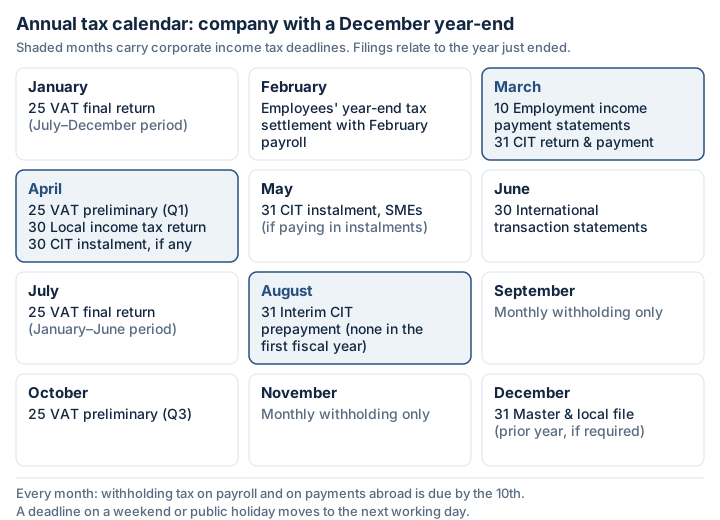
When are the returns and payments due?
The corporate income tax return and payment are due within three months after the end of the month in which the fiscal year ends (CITA Art. 60(1); Art. 64(1)). Companies that must file a sincere-filing confirmation get four months. A company that has a loss must still file (Art. 60(3)). An audited company whose audit is not finished can apply for a one-month extension, with interest (Art. 60(7), (8)). If more than KRW 10 million is due, part of it may be paid in instalments within one month after the deadline, or within two months for an SME (Art. 64(2)).
The corporate local income tax return is due within four months after the end of the year-end month (Local Tax Act, Art. 103-23(1)). For fiscal years beginning on or after 1 January 2026, companies that file a sincere-filing confirmation get five months.
Interim prepayment covers the first six months of the fiscal year. It is due within two months after that six-month period ends (CITA Art. 63(2), (3)). The company can calculate it as half of the previous year's tax or from its actual results for the six months (Art. 63-2(1)).
If a deadline falls on a weekend or public holiday, it moves to the next working day (Framework Act on National Taxes, Art. 5(1)).
How long can tax losses be carried forward?
Losses from fiscal years beginning on or after 1 January 2020 can be carried forward for 15 years (CITA Art. 13(1)(1)). Losses from earlier years keep the old 10-year period (Addenda to Act No. 17652, Arts. 4 and 15). Each year, a company can set off losses against no more than 80% of its income. SMEs, companies carrying out a court-approved rehabilitation plan and certain others can set off up to 100% (Art. 13(1) proviso). A loss can be carried forward only if it was reported in a return or appears in an assessment or an amended return (Art. 13(1)(1)(b)).
SME status is easy to get wrong. A company is not an SME if it is at least 30% owned by a corporation with total assets of KRW 500 billion or more and that corporation is its largest shareholder. The rule expressly includes foreign corporations (Enforcement Decree of the Restriction of Special Taxation Act, Art. 2(1)(3); Enforcement Decree of the Framework Act on SMEs, Art. 3(1)(2)(b)). Many subsidiaries of multinational groups therefore are not SMEs, however small they are in Korea.
Does minimum tax apply?
Minimum tax applies only to companies that claim certain tax incentives. After those incentives, tax cannot fall below 10% of taxable income up to KRW 10 billion, 12% on the part from KRW 10 billion to KRW 100 billion and 17% on the part above that. For SMEs, the minimum is 7% (Restriction of Special Taxation Act, Art. 132(1)).
What do foreign-owned subsidiaries most often miss in the first year?
The first fiscal year begins on the date the incorporation is registered (Enforcement Decree of the CITA, Art. 4(1)(1)). It ends on the year-end set in the articles of incorporation, and no fiscal year can be longer than one year (CITA Art. 6(1)). Income and expenses from before registration can be included in the first year only if that year still does not exceed one year (Decree Art. 4(2)).
- Interim payment begins in year two. A newly incorporated company is excluded in its first year (Art. 63(1)). If no tax arose in year one, the year-two payment is calculated from actual first-half results (Art. 63-2(2)(2)), unless the company is an SME below the KRW 500,000 threshold (Art. 63(1)(2)).
- Head-office charges need evidence. Management, IT and other group service fees are deductible only if all of these conditions are met: an agreement was signed in advance, the services were actually provided, the subsidiary could expect a benefit, no other group company is already providing the same service, and documents proving the agreement and the services are kept (Enforcement Decree of the Adjustment of International Taxes Act, Art. 12(7)). An invoice on its own does not meet these conditions.
- Withholding on payments abroad. Royalties, interest and dividends paid to the parent company are subject to Korean withholding tax at domestic rates of up to 20%, unless a tax treaty reduces the rate. The tax is due by the 10th of the following month (CITA Art. 98(1)). Withholding on payroll follows the same monthly cycle (Income Tax Act, Art. 128(1)).
- International transaction filings. A company with foreign related-party transactions must file an international transaction statement, summary income statements of those parties and a transfer pricing method report within six months after the year-end month (30 June for a December year-end). Small transaction volumes are exempt (Adjustment of International Taxes Act, Art. 16(2); Decree Art. 36). A master file and a local file are due within 12 months. They are required only if revenue exceeds KRW 100 billion and related-party transactions exceed KRW 50 billion (Art. 16(1); Decree Art. 34(1)).
What else should be on the radar?
- Entertainment expenses. The deductible amount is capped at KRW 12 million a year (KRW 36 million for SMEs), pro-rated by month, plus a percentage of revenue (CITA Art. 25(4)).
- Transfer pricing. Prices for related-party transactions must be at arm's length.
- Thin capitalisation. Some debt is linked to a foreign controlling shareholder: either borrowed from that shareholder or guaranteed by it. Interest on the portion of that debt above twice the shareholder's equity is generally not deductible (Adjustment of International Taxes Act, Art. 22(2)).
Enacted amendments effective 1 January 2027 and 2028 concern foreign corporations' Korean-source income, including virtual assets. They do not change the rates or deadlines above.
Common mistakes
- Using the 2025 rates (9% to 24%) for a fiscal year that began in 2026, or using the 2026 rates for a fiscal year that began during 2025.
- Forgetting that corporate local income tax is a separate return, filed with the local government one month after the national return.
- Not filing a return for a loss year. Without that return, the loss cannot be carried forward.
- Treating a subsidiary of a large group as an SME and claiming a 100% loss set-off or a two-month instalment period.
- Recording head-office recharges without a service agreement or proof that the services were provided.
FAQ
Our fiscal year began on 1 April 2025. Which rates apply?
The 2025 rates (9%, 19%, 21% and 24%) apply to that whole fiscal year. The 2026 rates apply from the fiscal year beginning 1 April 2026.
Does a company with a loss need to file?
Yes. Both the corporate income tax return and the local income tax return are required even if there is no taxable income (CITA Art. 60(3); Local Tax Act Art. 103-23(5)).
Can the year-end be changed later?
Yes, by reporting the change within three months after the end of the previous fiscal year. A late report means the change does not take effect (CITA Art. 7(1), (2)).
How we can help
We prepare and review corporate income tax and local income tax returns for foreign-owned companies in Korea, in English, and set up the filing calendar from the first year. We also check head-office service charges, withholding on payments abroad and international transaction filings before they become audit issues.
Arrange a free 30-minute consultation
Sources & further reading
- Korea Ministry of Government Legislation, Corporate Income Tax Act
- Korea Ministry of Government Legislation, Local Tax Act
- Korea Ministry of Government Legislation, Adjustment of International Taxes Act
- Korea Ministry of Government Legislation, Restriction of Special Taxation Act
- National Tax Service (English)
This article provides general information. Its application depends on your circumstances and the rules in force at the relevant time.