 Anse Accounting Corp.
A foreign company can enter Korea through a local subsidiary, a branch or a liaison office, and the choice decides what you may do in Korea, how far head office is exposed, and how profits are taxed and sent home. This guide compares the three side by side and shows when each one fits.
What are the three ways to set up in Korea?
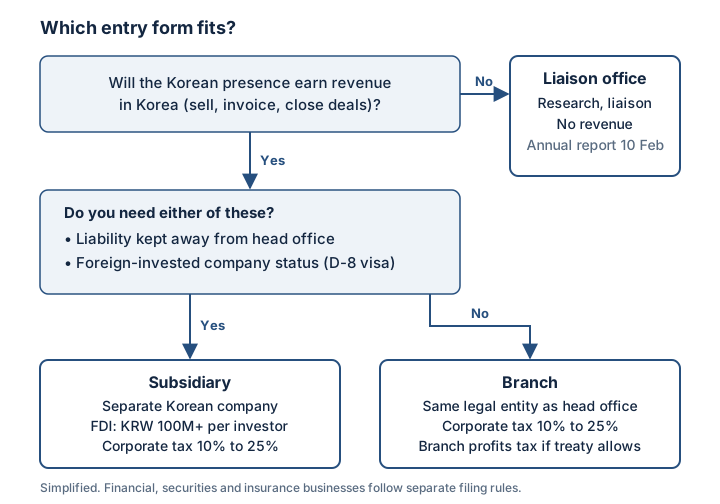
A foreign company usually enters Korea as a subsidiary (a Korean company it owns), a branch, or a liaison office. A subsidiary is set up under the Foreign Investment Promotion Act and the Commercial Act. Branches and liaison offices are both "domestic offices" under the Foreign Exchange Transactions Regulation, which separates them by one test: a branch carries on revenue-generating business in Korea, while a liaison office performs only non-business functions such as liaison, market research and R&D (Art. 9-32).
| Subsidiary | Branch | Liaison office | |
|---|---|---|---|
| Legal status | Separate Korean company | Part of the foreign company | Part of the foreign company |
| Revenue in Korea | Yes | Yes | No |
| Legal basis | Foreign Investment Promotion Act, Commercial Act | Foreign Exchange Transactions Regulation, Commercial Act Art. 614 | Foreign Exchange Transactions Regulation |
| Head office liability | Limited to capital subscribed | Head office is the debtor | Head office is the debtor |
| Minimum investment | KRW 100 million per investor for FDI status | None set | None set |
| Corporate tax | Worldwide income, 10% to 25% | Korean-source income, 10% to 25% | None while non-business |
| Profits sent home | Dividend withholding, 20% or treaty rate | Branch profits tax only if the treaty allows | Not applicable |
| Court registration | Yes | Yes, within 3 weeks | No |
What can a liaison office do, and when does it become taxable?
A liaison office may not earn revenue in Korea. The Corporate Income Tax Act describes it as an office limited to non-business functions such as liaison, market research and information gathering that are preparatory or auxiliary to the foreign company's business (Art. 94-2; Enforcement Decree Art. 133-2).
As long as it stays that way, it is not a permanent establishment: no corporate tax and no VAT registration. It receives a tax ID number instead, and must file an annual status report by 10 February of the following year, together with a summary of purchase invoices received (Art. 94-2(1) and (2)). If the report is missing or false, the tax office can order a correction within 30 days (Art. 94-2(4)).
The risk is drift. A place used only for purchasing, storage, advertising, information or market research is excluded from a permanent establishment only while that work stays preparatory or auxiliary, and not if it complements a business the group already runs in Korea (Art. 94(4) and (5)). Staff who habitually conclude contracts, or play the principal role leading to them, can create a permanent establishment on their own (Art. 94(3)). The National Tax Service has treated an office that developed samples and designs for head office as a permanent establishment, because that work was a core part of the business (ruling 국일46017-374, 1998). A treaty's permanent establishment article can narrow this, so check both.
How is a branch taxed, and does branch profits tax apply?
A branch is a permanent establishment. It files a Korean corporate tax return and pays the same rates as a Korean company, 10%, 20%, 22% and 25% across four bands (Corporate Income Tax Act Art. 95, applying Art. 55), plus local income tax. It registers for VAT within 20 days of starting business (VAT Act Art. 8).
Branch profits tax is a second layer. Article 96 lets Korea tax a branch's after-tax profits only where the treaty with the head office's country allows it, and not where that country does not tax Korean companies' branches in the same way. The domestic rate is 20%, unless the treaty sets a lower one. Two examples:
- Canada: up to 5% of branch earnings not previously subject to the tax (Korea-Canada treaty, Art. 10(6)).
- Philippines: up to 10% of profits remitted to head office (Korea-Philippines treaty, Protocol para. 5).
The taxable amount is the year's profit less corporate tax, local income tax and amounts treated as reinvested in Korea (Art. 96(2); Enforcement Decree Art. 134). Where the treaty does not allow the tax, profits go home without it.
Profits leave through the branch's designated foreign exchange bank. The branch submits its financial statements and a tax payment certificate, plus an auditor's certificate if net profit exceeds KRW 100 million or is at least equal to the operating funds brought in (Foreign Exchange Transactions Regulation Art. 9-35).
When is a subsidiary the better choice?
Choose a subsidiary when head office must be kept apart from Korean liabilities, or when you want foreign-invested company status. A stock company's shareholders are liable only up to the price of the shares they subscribed for (Commercial Act Art. 331); a branch has no such wall.
Foreign direct investment means at least KRW 100 million per investor that gives the investor 10% or more of the voting shares, or a shareholding together with the right to appoint officers (Enforcement Decree of the Foreign Investment Promotion Act Art. 2(2) and (3)). That status brings a statutory guarantee that dividends and share sale proceeds can be remitted (Act Art. 3(1)) and access to the D-8 corporate investment visa for essential staff. Branches and liaison offices are not shut out of visas: the D-7 intra-company transfer status covers staff posted after at least one year with the foreign company (Enforcement Decree of the Immigration Act, Annex 1-2).
A subsidiary is taxed on its worldwide income at the same 10% to 25% rates, and its dividends to the parent bear 20% withholding tax or the lower treaty rate (Corporate Income Tax Act Art. 98(1)(2)).
What do you file to set each one up?
- Subsidiary. File a foreign investment notification before investing (Foreign Investment Promotion Act Art. 5), remit the capital, register the company at court, then register for tax and as a foreign-invested company.
- Branch. Report to a designated foreign exchange bank with proof of the head office's name, address and business and a description of the Korean business (Foreign Exchange Transactions Regulation Art. 9-33). Appoint a Korean representative and register at court within three weeks (Commercial Act Art. 614). File a permanent establishment report with the tax office within two months (Corporate Income Tax Act Art. 109(2)) and register for VAT.
- Liaison office. Report to the designated bank in the same way, then obtain a tax ID number.
Non-bank financial, securities and insurance-related businesses report to the Ministry of Economy and Finance instead of a bank (Art. 9-33(2)).
How hard is it to close or convert later?
A liaison office is generally the easiest to close and a subsidiary the slowest. Closing a branch or liaison office starts with a closure report to the bank, and remitting the remaining assets needs a tax payment certificate (Art. 9-37). A branch's tax year ends on closure (Corporate Income Tax Act Art. 8(6)), and where branch profits tax is levied on remittances, unremitted profit is treated as remitted that day (Enforcement Decree Art. 134(7)). A subsidiary must be dissolved and liquidated, with a creditor claim period of at least two months (Commercial Act Art. 535).
Converting a branch into a subsidiary is a new investment, not a re-registration. Assets distributed on closing a branch can be contributed as capital to the new company (Foreign Investment Promotion Act Art. 2(1)(8)(e)). Moving them can trigger tax on built-in gains, but the National Tax Service has confirmed that a foreign company with a Korean permanent establishment can defer that gain if every condition of the contribution-in-kind rule is met, including five years in business and at least 80% ownership of the new company (Corporate Income Tax Act Art. 47-2; ruling 서면-2016-국제세원-4771). A transfer of the whole business at the site is generally not a VAT supply (VAT Act Art. 10(9)(2)).
Common mistakes
- Selling through a liaison office. Once it quotes, negotiates or invoices, it can be taxed as a permanent establishment from when that activity began.
- Treating R&D as automatically safe. The foreign exchange rules list R&D as a liaison function, but the tax exclusion covers only preparatory or auxiliary work.
- Assuming branch profits tax always applies, or never does. It depends on the treaty with the head office country.
- Forgetting the liaison office's 10 February report. It is due every year, even with no income.
- Planning a branch-to-subsidiary switch late. The tax-deferral conditions must be met on the transfer date.
FAQ
Is there a minimum capital for a branch?
The Foreign Exchange Transactions Regulation sets none; operating funds must come in through the designated bank (Art. 9-34). The KRW 100 million threshold applies only to investment in a Korean company.
Does a branch pay less tax than a subsidiary?
Not on its profits: both pay 10% to 25%. The difference is the second layer: dividend withholding for a subsidiary, branch profits tax for a branch only where the treaty allows it.
Can we start with a liaison office and upgrade later?
Yes. A liaison office can handle research and contacts while you test the market, and a branch or subsidiary can follow when sales are about to start. Open the new entity before the first sale.
How we can help
We help foreign companies choose the right entry form before the first filing and set it up with tax registrations, treaty checks and the reporting calendar in place. The two partners who advise you previously worked at PwC Korea and consult in English, and we reply within one business day.
Arrange a free 30-minute consultation
Sources & further reading
- Invest KOREA, How foreigners can start business in Korea
- Invest KOREA, Definition of foreign direct investment
- Corporate Income Tax Act
- Enforcement Decree of the Corporate Income Tax Act
- Foreign Investment Promotion Act
- Enforcement Decree of the Foreign Investment Promotion Act
- Foreign Exchange Transactions Regulation
- Commercial Act
- Value-Added Tax Act
- Enforcement Decree of the Immigration Act
- National Tax Service (English)
This article provides general information. Its application depends on your circumstances and the rules in force at the relevant time.