 Anse Accounting Corp.
Korea charges VAT at 10%, and a Korean subsidiary must register, issue electronic tax invoices and file on a quarterly rhythm. This guide explains when services between a foreign parent and its Korean subsidiary are zero-rated, when the Korean side must self-assess VAT, and how foreign digital service providers register.
What VAT rate applies in Korea, and who has to register?
The VAT rate is 10% of the supply value (VAT Act Art. 30), and every business supplying goods or services in Korea must register each place of business within 20 days of starting business (Art. 8(1)). Registration is allowed before trading starts, and a new subsidiary should register as soon as it is incorporated.
Late registration costs twice. A penalty of 1% of the supply value up to the day before registration is added (Art. 60(1)). Input VAT on earlier purchases is also lost, unless the company registers within 20 days after the end of the six-month taxable period in which the purchase was made (Art. 39(1)8).
When are VAT returns due, and how are refunds paid?
Korea has two six-month taxable periods, January to June and July to December (Art. 5), each with a three-month preliminary period. Returns and payment are due 25 days after each period ends (Arts. 48 and 49).
| Period covered | Return | Due date |
|---|---|---|
| 1 January – 31 March | Preliminary return (1st period) | 25 April |
| 1 January – 30 June | Final return (1st period) | 25 July |
| 1 July – 30 September | Preliminary return (2nd period) | 25 October |
| 1 July – 31 December | Final return (2nd period) | 25 January |
A corporation whose supply value in the previous taxable period was under KRW 150 million does not file the preliminary return. The tax office instead issues a notice for 50% of the previous period's tax (Art. 48(3); Enforcement Decree Art. 90(4)).
Excess input VAT is refunded within 30 days after the final return deadline (Art. 59(1)). Businesses making zero-rated supplies, acquiring depreciable business assets or carrying out an approved financial restructuring plan can claim early refunds (Art. 59(2)). They file for each month or two-month block and are refunded within 15 days after the filing deadline (Decree Art. 107(4)), which helps exporters and companies buying equipment during set-up.
What are the electronic tax invoice rules?
Every corporation must issue tax invoices electronically (Art. 32(2)) and transmit them to the NTS by the day after issuance (Art. 32(3); Decree Art. 68(7)). The invoice is due at the time of supply, or by the 10th of the following month if a customer's supplies for the month are consolidated into one invoice (Art. 34(3)).
| Failure (VAT Act Art. 60(2)) | Penalty (% of supply value) |
|---|---|
| Invoice issued late, but by the final return deadline | 1% |
| Invoice not issued by the final return deadline | 2% |
| Paper invoice issued where an e-invoice was required | 1% |
| E-invoice transmitted late, but by the final return deadline | 0.3% |
| E-invoice not transmitted by the final return deadline | 0.5% |
Which input VAT is not recoverable?
Input VAT on purchases for the business is generally deductible (Art. 38), with these exceptions among others (Art. 39(1)):
- purchases without a valid tax invoice, or with key invoice details missing or wrong
- expenses not directly related to the business
- buying, leasing and running passenger cars covered by the Individual Consumption Tax Act, unless used directly in a business such as transport or car sales
- business entertainment expenses
- costs of VAT-exempt activities, and certain land-related costs
- purchases made before registration, outside the 20-day window above
Leased cars for staff and client entertainment are the items most easily missed.
When are services to a foreign parent zero-rated?
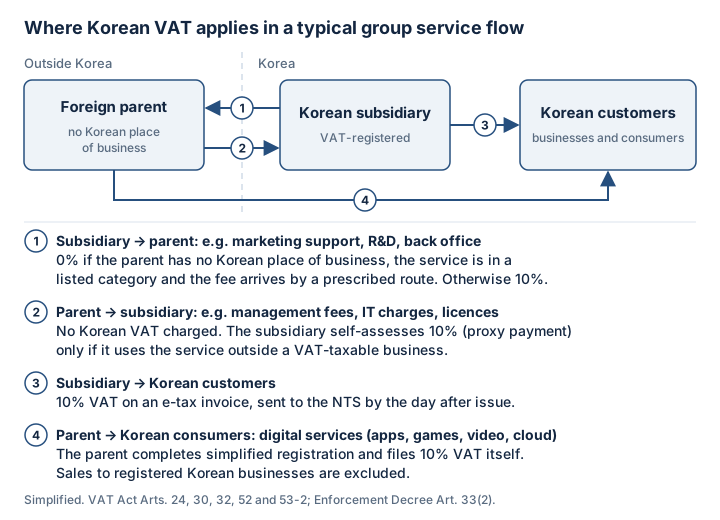
A subsidiary's services to its foreign parent are taxed at 0% only when every condition in VAT Act Art. 24(1)3 and Enforcement Decree Art. 33(2) is met:
- Recipient: the parent has no place of business in Korea. If it has one, the service must be contracted directly with, and paid by, the foreign head office (Decree Art. 33(2)2).
- Service type: the service is in a listed category, such as professional, scientific and technical services; software development, programming, data processing and hosting; licensing of intangible property; commodity brokerage; business support services; or clinical trials. Head-office services are excluded from the professional and technical category.
- Payment route: the fee arrives through a Korean foreign-exchange bank and is received in won, or by a prescribed method (Enforcement Rule Art. 22). These include a direct foreign-currency remittance sold to a bank, a deposit into a foreign-currency account confirmed by a bank certificate, or netting against amounts owed to a parent with no Korean place of business.
- Reciprocity: for professional services, business support services and investment advisory, the parent's country must exempt Korean businesses in the same way, or have no VAT or similar tax.
Exports of goods (Art. 21), services performed outside Korea (Art. 22) and international transport by ship or aircraft (Art. 23) are also zero-rated. A zero-rated supply is still taxable, so related input VAT stays deductible. Zero-rated sales filed without the prescribed supporting documents are treated as not filed (Decree Arts. 90(8) and 91(3)).
| Transaction | Korean VAT | Who accounts for it | Basis |
|---|---|---|---|
| Subsidiary sells to Korean customers | 10% | Subsidiary, on an e-tax invoice | Arts. 30, 32 |
| Subsidiary exports goods | 0% | Subsidiary | Art. 21 |
| Subsidiary performs services outside Korea | 0% | Subsidiary | Art. 22 |
| Subsidiary provides listed services to a parent with no Korean place of business, paid by a prescribed route | 0% | Subsidiary, with supporting documents | Art. 24; Decree Art. 33(2) |
| Same service, a condition not met | 10% | Subsidiary | Art. 30 |
| Parent with no Korean place of business supplies services used in the subsidiary's taxable business | No Korean VAT | Nobody | Art. 52(1) |
| Foreign services used in VAT-exempt activities or for non-deductible purposes | 10% proxy payment | Korean buyer | Art. 52 |
| Foreign provider sells digital services to Korean consumers | 10% | Provider, via simplified registration | Art. 53-2 |
| Goods imported into Korea | 10% import VAT | Importer, with customs duty | Art. 50 |
When must a Korean business self-assess VAT on foreign services?
A Korean business buying services or rights from a foreign provider with no Korean place of business must collect 10% VAT when it pays and remit it itself. This is proxy payment (Art. 52(1)). It applies only when the buyer does not use the service in a VAT-taxable business, or when the input VAT would be non-deductible under Art. 39. A fully taxable subsidiary paying its parent's management fees or IT charges for ordinary business use has nothing to remit.
Proxy payment matters most for banks, insurers and other businesses with exempt activities (Art. 26(1)), and for services linked to non-deductible items. The tax is reported on a proxy payment return and paid with the preliminary or final return (Art. 52(2); Decree Art. 95). Late payment attracts a 3% penalty plus daily interest, the two together capped at 10% of the unpaid tax (Framework Act on National Taxes Art. 47-5).
How do foreign digital service providers register?
A foreign company selling electronic services to Korean consumers must complete an online "simplified business registration" within 20 days of starting (Art. 53-2(1)). Covered services include games, audio, video and software; advertising; cloud computing; and online intermediation. The company files preliminary and final returns online and pays 10% VAT into a designated foreign-exchange bank account (Art. 53-2(4); Decree Art. 96-2(5)–(6)). Sales to registered Korean businesses are outside the regime; the ordinary proxy payment rules apply to those.
Where an app store, online marketplace or payment-collecting intermediary sits between the provider and the customer, that platform is treated as the supplier and registers instead (Art. 53-2(2)). Records must be kept for five years (Art. 53-2(6)), and late registration attracts a 1% penalty (Art. 60(1)1-2).
Common mistakes
- Treating every service to the parent as zero-rated without checking the category, the parent's place of business, the payment route and reciprocity.
- Omitting the zero-rating documents, so that part of the return is treated as not filed.
- Issuing paper or late e-invoices before the accounting system can transmit to the NTS.
- Ignoring proxy payment on foreign services used in exempt activities or non-deductible spending.
- Registering after trading has begun and losing input VAT on set-up costs.
FAQ
Does a foreign company without a Korean entity need to register for VAT?
Usually not, if it only sells business services from abroad to Korean companies; the customer handles any proxy payment. It must register if it sells digital services to Korean consumers (simplified registration) or carries on business through a place of business in Korea (Art. 8).
Can the subsidiary charge 0% to its parent and still recover input VAT?
Yes. Zero-rated supplies are taxable at 0%, so related input VAT is deductible, and early refunds can be claimed monthly or every two months (Art. 59(2); Decree Art. 107(4)).
What if a Korean affiliate pays the subsidiary's fee in won on the parent's behalf?
Zero rating becomes doubtful. The prescribed routes generally require money from abroad through a foreign-exchange bank, or netting with a parent that has no Korean place of business (Enforcement Rule Art. 22). Agree the payment route before the first invoice.
Are any VAT changes scheduled?
As at 24 October 2026, no amendment to the VAT Act, its Enforcement Decree or its Enforcement Rule has been promulgated with a future effective date. Check again before 2027 begins.
How we can help
We map intra-group service flows, confirm which fees qualify for zero rating, and document the payment route and reciprocity position before the first invoice. For new subsidiaries we also set up VAT registration, e-invoicing and the filing calendar, and prepare early refund claims during set-up. Our partners advise in English.
Arrange a free 30-minute consultation
Sources & further reading
This article provides general information. Its application depends on your circumstances and the rules in force at the relevant time.