 Anse Accounting Corp.
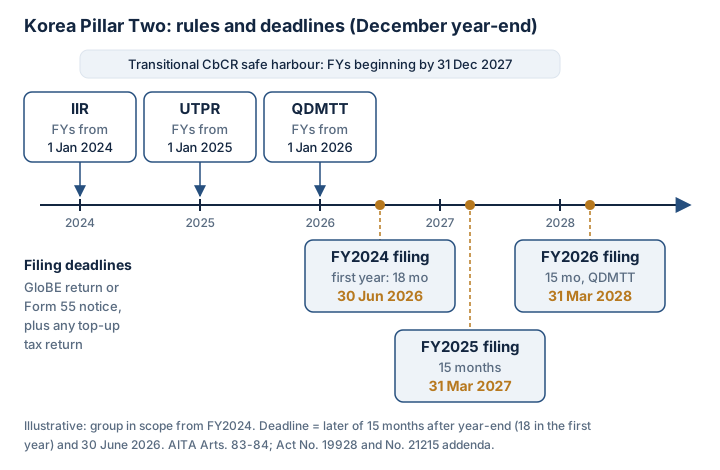
Korea applies the Income Inclusion Rule from 2024, the Undertaxed Profits Rule from 2025 and its own domestic top-up tax from 2026. This guide explains which groups are in scope, what a Korean subsidiary of a foreign group must file and by when, how the transitional CbCR safe harbour works, and what is left in Korea when the parent's country already applies the IIR.
Is our Korean subsidiary within Korea's global minimum tax?
Yes, if the group is large enough. The rules apply for a fiscal year if the ultimate parent's consolidated revenue was EUR 750 million or more in at least two of the four preceding fiscal years (Adjustment of International Taxes Act (AITA), Art. 62(1)). A fiscal year shorter or longer than 12 months is annualised.
Each group company or permanent establishment in Korea is a "domestic constituent entity" and pays any Korean top-up tax as corporate income tax (Art. 63). Government entities, international organisations, non-profits, pension funds, and investment funds or real estate vehicles that are ultimate parents are excluded (Art. 62(3)). As of 24 October 2026, no promulgated amendment to these rules (AITA Chapter 5) is waiting to take effect.
Which rules apply in Korea, and from when?
Korea has introduced all three charging rules in stages.
| Rule | Fiscal years beginning on or after | What it means for a Korean subsidiary of a foreign group |
|---|---|---|
| Income Inclusion Rule (IIR) | 1 January 2024 | Usually nothing. It applies only if the Korean company is itself a parent of low-taxed entities, and an intermediate parent is switched off when the ultimate parent applies a qualified IIR (Art. 72(4)) |
| Undertaxed Profits Rule (UTPR) | 1 January 2025 | A backstop. Korea's share is allocated 50% by employees and 50% by tangible assets (Art. 73(4)), and is zero for a low-taxed entity fully covered by a qualified IIR (Art. 73(3)) |
| Domestic top-up tax (QDMTT) | 1 January 2026 | Korean entities pay top-up tax if the group's Korean effective tax rate is below 15% (Arts. 73-6, 73-7) |
| GloBE return or notification | First in-scope year | Required from every in-scope Korean entity, even if no tax is due (Art. 83) |
Has Korea introduced a domestic minimum top-up tax?
Yes, from fiscal years beginning on or after 1 January 2026. For a December year-end group, FY2026 is the first year.
The tax is computed for all Korean group entities together: the 15% minimum rate less the group's Korean effective tax rate, multiplied by Korean excess profit after the substance-based income exclusion (Art. 73-6). The filing entity then allocates it among the Korean entities, either by a statutory formula or, if all Korean entities agree, to one or more designated entities (Art. 73-7(2)).
Korea's own rules reduce top-up tax by any qualified domestic top-up tax paid in another country (Art. 70(5)). Whether the parent's country credits Korea's tax in the same way depends on that country's law.
What must a Korean subsidiary file, and by when?
The deadline is the later of 15 months after year-end (18 months for the first year) and 30 June 2026 (Art. 83(1); Enforcement Decree Art. 141(1)). For a December year-end group in scope from FY2024, that means 30 June 2026 for FY2024, 31 March 2027 for FY2025 and 31 March 2028 for FY2026.
- GloBE information return (Enforcement Rule Forms 53 and 54), filed electronically, with amounts in the currency of the consolidated accounts (Decree Art. 141(1)).
- Notification instead of a return (Form 55). A Korean entity need not file its own return if a group entity abroad files it in a country with an exchange agreement in effect with Korea for that year (Art. 83(3); Decree Art. 141(3)). It must still notify the tax office of the foreign filer by the same deadline (Art. 83(4)).
- Designated local entity. One Korean group company can file for all Korean entities (Art. 83(2); Decree Art. 141(2)). Form 55 marks which one it is. We found no separate designation deadline in the Act or Decree.
- Top-up tax return and payment, if any Korean tax is due, by the same deadline (Art. 84(1)-(2)). Amounts over KRW 10 million can be paid partly in instalments within one month, or two months for an SME (Art. 84(3)).
A missing or false return or notification carries a fine of up to KRW 100 million, plus up to KRW 200 million more if not corrected within 30 days of a demand (Art. 87; Decree Art. 144(2)). For transitional years, no fine applies if the company shows good-faith compliance efforts (Decree Art. 144(3)). Top-up tax for those years carries no failure-to-file or under-reporting penalty, and late-payment penalty is halved (Art. 84(5)).
How does the transitional CbCR safe harbour work in Korea?
It lets the filing entity elect to treat a country's top-up tax, including Korea's domestic top-up tax, as zero, using qualified country-by-country report data (Art. 80(1)). Korea now covers fiscal years beginning on or before 31 December 2027 and ending on or before 30 June 2029 (Decree Art. 138(1)). A country qualifies if it meets one of three tests (Decree Art. 138(2)).
- De minimis: revenue below EUR 10 million and profit before tax below EUR 1 million.
- Simplified effective tax rate: at least 15% for years beginning in 2024, 16% in 2025, and 17% in 2026 and 2027.
- Routine profits: a loss, or profit no greater than the substance-based income exclusion.
The election is annual (Decree Art. 138(3)). A country left out in one transitional year cannot use it in later years (Decree Art. 138(4)(v)). Separately, a UTPR safe harbour treats the ultimate parent's country as having no UTPR top-up tax if its nominal corporate tax rate is at least 20%, for fiscal years beginning by 31 December 2025 and ending by 30 December 2026 (Art. 80(3); Decree Art. 138(6)). A safe harbour sets the tax to zero. It does not remove the Article 83 filing.
If the parent's country already applies the IIR, what is left in Korea?
Usually no Korean IIR and, where the parent's qualified IIR fully covers a low-taxed entity, no Korean UTPR. Three things remain.
- Filing. A GloBE return, or a Form 55 notification if the foreign return is exchanged.
- Domestic top-up tax from FY2026. If the group's Korean effective tax rate is below 15%, Korea now collects that top-up tax first.
- Data. Head office needs Korean covered taxes, deferred taxes, payroll and tangible assets. Where staff work or assets sit partly outside Korea, the company must keep records of hours and days (Enforcement Rule Art. 75(7)-(8)).
In partly owned structures, part of a low-taxed entity's top-up tax may fall outside the parent's IIR and reach Korean entities through the UTPR.
Common mistakes
- Assuming nothing is due in Korea because head office files the GloBE return. The Form 55 notification is still required.
- Assuming Korea has no domestic top-up tax. It applies from FY2026 for a December year-end.
- Using 15 months for the first in-scope year, or a deadline earlier than 30 June 2026.
- Treating the CbCR safe harbour as automatic. It is an annual election, and a country that drops out cannot return.
FAQ
Our Korean company is small. Can it still be in scope?
Yes. The EUR 750 million test uses the ultimate parent's consolidated revenue, not the Korean company's (Art. 62(1)).
Does the Korean domestic top-up tax apply to FY2025?
No. It applies to fiscal years beginning on or after 1 January 2026 (Act No. 21215, Addenda Art. 3). For FY2024 and FY2025, Korean entities could be exposed only to the IIR or the UTPR.
We have several Korean companies. Must each file separately?
No. One Korean group company can be designated to file the return or notification for all of them (Art. 83(2)).
How we can help
We help foreign groups confirm which Korean entities are in scope, prepare the Korean GloBE filings or Form 55 notifications, and work through the domestic top-up tax and safe harbour positions with head office. You get a Korean deadline calendar and data checklist in English before the first filing is due.
Arrange a free 30-minute consultation
Sources & further reading
This article provides general information. Its application depends on your circumstances and the rules in force at the relevant time.