 Anse Accounting Corp.
Foreign employees in Korea can elect a 19% flat income tax on their salary for up to 20 years instead of the 6–45% progressive rates. This guide explains who is excluded, what deductions you give up, where the break-even point lies, which forms to file, and a pending 2027 proposal to raise the rate.
Who can elect the 19% flat rate?
A non-Korean officer or employee can elect it if their first day of work in Korea falls on or before 31 December 2026 (Restriction of Special Taxation Act, Art. 18-2(2)). It then covers employment income for every tax year that ends within 20 years of that day.
The other conditions:
- No Korean nationality at the end of the tax year, or on the application date for monthly withholding. Dual nationals holding Korean nationality are generally excluded (Enforcement Decree, Art. 16-2(4) and (6)).
- Not a daily worker.
- Not employed by a related company. The relief is denied if the employee has a family or management-control relationship with the employer, as defined in the Framework Act on National Taxes Enforcement Decree, Art. 1-2. This typically catches a foreign founder or controlling shareholder working for their own Korean company. There is an exception: the exclusion does not apply if, at year-end, the employer receives foreign-investment tax relief or meets its requirements (Enforcement Decree, Art. 16-2(1) and (2)).
The 20-year period has applied since 2023. It also covers people still inside 20 years of their first working day; the previous limit was five years. For anyone who first worked in Korea before 2014, the National Tax Service treats 1 January 2014 as the first working day. If that person left and later returned, the clock starts on the first working day after re-entry on or after that date (ruling Sajeon-2023-Beopgyugukjo-0624).
What do you give up with the flat rate?
You give up almost all relief. Under Art. 18-2(3), no non-taxable income items, income deductions, reductions or tax credits apply. The 19% is charged on gross employment income, including allowances that would otherwise be tax-free.
The one exception is the benefit of company-provided housing. It stays non-taxable for income paid from 1 January 2024 (Income Tax Act Enforcement Decree, Art. 17-4, item 1).
Flat-rate income is also kept out of the global income tax base, so it does not push other income, such as rental income, into higher brackets.
How does it compare with the progressive rates?
Below roughly ₩135 million of salary the progressive rates usually win; above it the flat rate generally saves tax. The 2026 scale runs from 6% to 45% (Income Tax Act, Art. 55(1)). Local income tax adds a tenth of each rate (Local Tax Act, Art. 92(1)).
| Taxable income (KRW) | National income tax | Local income tax | Combined marginal rate |
|---|---|---|---|
| Up to 14 million | 6% | 0.6% | 6.6% |
| 14–50 million | 15% | 1.5% | 16.5% |
| 50–88 million | 24% | 2.4% | 26.4% |
| 88–150 million | 35% | 3.5% | 38.5% |
| 150–300 million | 38% | 3.8% | 41.8% |
| 300–500 million | 40% | 4.0% | 44.0% |
| 500 million–1 billion | 42% | 4.2% | 46.2% |
| Over 1 billion | 45% | 4.5% | 49.5% |
| Flat-rate election | 19% of gross salary | 1.9% | 20.9% flat |
The progressive brackets apply to taxable income, which is salary after deductions. The flat rate applies to gross salary. So the two must be compared in total tax, not by rate.
Illustrative example. Take a single resident with ₩200 million of salary and no other income. On the progressive basis:
- Taxable income is ₩181.75 million. That is after the ₩16.75 million employment income deduction (Art. 47) and the ₩1.5 million basic deduction for the employee (Art. 50).
- National tax under Art. 55 is ₩49.125 million.
- The employment tax credit at this salary level is ₩200,000 (Art. 59), leaving ₩48.925 million.
- With local tax, the total is about ₩53.82 million.
The flat rate gives ₩38 million plus ₩3.8 million of local tax, or ₩41.8 million, about ₩12 million less. At ₩100 million of salary the result reverses: about ₩15.22 million progressive against ₩20.9 million flat.
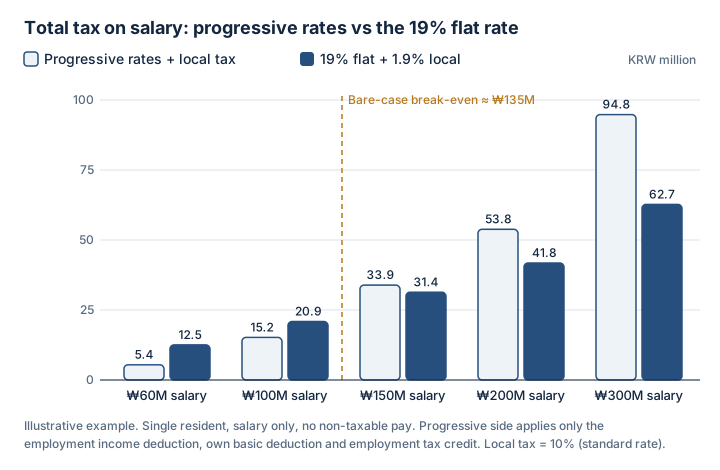
The example ignores social-insurance deductions, dependants, the standard tax credit and tax-free allowances. All of these lower only the progressive figure, so a real employee's break-even is usually higher. Run the comparison on actual figures each year.
How and when do you apply?
There are two filings, and you can use one or both.
- Annual election. Attach the single-rate application (Form 8 of the Enforcement Rule) to the employee's income and tax-credit declaration. File it with the employer at year-end settlement (February payroll), or with the May global income tax return (Enforcement Decree, Art. 16-2(4)).
- Monthly 19% withholding. File the withholding application (Form 8-2) through the employer by the 10th of the month after the month of work (Art. 18-2(4); Decree Art. 16-2(6)). A waiver on the same form stops it from the next tax year (Art. 16-2(7)).
The employer also withholds local income tax at 10% of the income tax withheld, which gives the 1.9% (Local Tax Act, Art. 103-13).
If the election was missed, the difference may still be recoverable through a correction claim, generally within five years (Framework Act on National Taxes, Art. 45-2). The Tax Tribunal has treated the application as a procedural duty rather than a condition of the relief (Josim 2020Jung8363).
What about other relief and expatriates paid from abroad?
Qualifying foreign engineers and researchers can claim a separate relief instead: a 50% income tax reduction for 10 years (Restriction of Special Taxation Act, Art. 18). Their first work in Korea must fall on or before 31 December 2026. Because the flat rate switches off all reductions, an eligible engineer must compare the two, not combine them.
For seconded staff, salary paid directly by an overseas head office generally falls outside Korean payroll withholding (Income Tax Act, Art. 127(1)4(b)). It is still Korean employment income and must be settled through a taxpayer association (Art. 149) or the May return. The flat-rate election should cover that offshore-paid portion too. There is one exception: under a worker-dispatch contract, the Korean company using the worker withholds at the Art. 18-2 rate when it pays the dispatch fee (Art. 156-7).
What to watch
- The 2027 proposal. The government's 2026 tax reform proposal, announced in August and now before the National Assembly, would raise the flat rate to 21% (23.1% with local tax) for income arising from 1 January 2027. It would also extend the first-work deadline to 31 December 2029. It had not been enacted as of 24 October 2026. If it passes as proposed, the bare-case break-even in our example rises to roughly ₩155 million.
- Tax-free allowances. Tax-free allowances become taxable under the flat rate. Payroll systems often miss this.
- Related-party status. It is tested at each year-end, and a change in shareholding can switch the relief off.
- Offshore-paid salary. It is easy to leave out of both the election and the return.
FAQ
Can the employee switch between flat and progressive each year?
Generally yes. The annual election is made at year-end settlement or in the May return, so it can be compared year by year. A monthly 19% withholding election, however, stays until a waiver is filed, and the waiver takes effect only from the next tax year.
Does the 20-year clock restart after leaving Korea?
No. The period runs from the first day of work in Korea. The only special rule is for people who first worked in Korea before 2014, described above.
Is local income tax also flat?
In effect, yes. It is withheld at 10% of the income tax withheld, which gives 1.9% of gross salary.
How we can help
We run the flat-versus-progressive comparison on the employee's actual pay package and check related-party status and offshore-paid salary. We then prepare the year-end and withholding filings in English, and reply within one business day.
Arrange a free 30-minute consultation
Sources & further reading
This article provides general information. Its application depends on your circumstances and the rules in force at the relevant time.